
Blu Putnam, Chief Economist at Stock Trader Network, Blu(e)prints By Bayesian Edge
The Federal Reserve’s Federal Open Market Committee (FOMC) left its federal funds rate target range unchanged at its meeting today, July 29, 2026. The press release was incredibly concise. The main news was that there were three dissenting votes for a rate hike from three regional Fed Bank Presidents: Beth Hammock (Cleveland), Neel Kashkari (Minneapolis), and Lorie K. Logan (Dallas). There were no dissents from members of the Fed’s Board of Governors, regardless of which President appointed them. There is definitely more fireworks coming at the mid-September FOMC meeting and perhaps more dissenting votes. But is the debate about whether to raise rates a quarter of percentage point because the Iran War has triggered a surge in gasoline prices really the appropriate debate.
The Federal Reserve (Fed) has lost considerable ability to influence the path of US inflation over the decades, especially since the 1980s. The US economy is simply not as sensitive to short-term interest rate changes as it once was. The reality is that small changes in short-term interest rates, say just one or two 25 basis points (i.e. 0.25%) increases or decreases are not going to matter much, if at all, for the economy or inflation, even if asset prices are still responsive. This is not to say that the Fed no longer has any influence. Big interest rate hikes could still cause a recession, as they did in 1980-82, again in 1990-91 and 2008-09, but fine-tuning short-term interest rates may simply not be worth the effort given the uncertainty it creates.
The decreased sensitivity of the US economy to Fed policy adjustments raises the question whether the Fed’s Federal Open Market Committee (FOMC) and the financial press are both wasting a lot of time debating whether to hike rates or not in the face of currently elevated inflation coming from the Iran War. We would enjoy seeing a robust debate on whether inflation is now mostly endogenous to the
interplay inside our complex economic system and rather than being guided by an all powerful central bank and what a less interest rate sensitive economy means for the appropriate conduct of Fed policy.
Let’s frame the debate and concisely go through several of the challenges to understanding the determinants of inflation in our complex modern economy. This will require a few history lessons regarding the path of inflation and its causes. Revisiting Milton Friedman
“Inflation is always and everywhere a monetary phenomenon”, wrote Milton Friedman in 1970.
If one assumes as Professor Friedman did back in the 1950s, 60s, and 70s, that the Fed could control the money supply and that the velocity of money as it traveled though the economy was relatively constant, then it followed that the central bank should be charged with the objective of encouraging relative price stability.
But Professor Friedman was a very careful with his logic. The full quote is:
“It follows from the propositions I have so far stated that inflation is always and everywhere a monetary phenomenon in the sense that it is and can be produced only by a more rapid increase in the quantity of money than in output. However, there are many different possible reasons for monetary growth, including gold discoveries, financing of government spending, and financing of private spending.“
Wait! What? There can be many reasons for monetary growth? Notable economists have studied how the reasons for monetary growth have changed over the decades, and their insights are informative to our debate. Take the late Nobel Laureate Christopher Sims who has argued among other things that while central banks can control short-term interest rates, once the short-term interest rate is set, private
economic agents respond and endogenously determine the quantity of money.
Empirically, Sims has also argued that the old textbook explanation of the central bank money multiplier does not match reality, and that inflation is linked to fiscal policy and government debt as well as interest rate policy. Sims has many followers, including ourselves.
Additional reasons for the US economy becoming less interest rate sensitive include the expansion of financial risk management, especially with interest rate futures and options. The volumes traded on CME Group interest rate contracts are huge, and the major growth started in the late 1990s with electronic trading and CME’s introduction of the GLOBEX trade match engine underlying its futures and options markets. If the financial sector does a better job of interest rate risk management, then small changes in interest rates are not going to have much impact on bank lending activities.
Why did monetarism work so well in 1950s through 1970s and then fail in the 1980s?
Monetarism, meaning the growth rate of the money supply was a good predictor of inflation 12 to 18 months down the road, worked well from the 1950s through the 1970s. What ended the growth of the money supply as a useful forecasting tool were myriad changes to how consumers made payments and how the Fed managed the monetary base.
The money supply only works as a predictor of inflation if there is a relatively tight empirical relationship between standard measures of the money supply (i.e., M1 or M2) and consumer spending. From the 1950s through the 1970s, consumers either paid cash or wrote a check from their bank account to purchase goods and services.
In the late 1970s, brokerage houses were allowed to pay interest on money in their accounts. Clients were allowed to write a limited number of checks on the money in their brokerage accounts. And banks were allowed to pay interest on checking accounts. These changes blurred the line between bank accounts, savings accounts, and brokerage accounts. Money could now move easily between these accounts both to cover payments but also to earn interest and be a critical part of one’s investment portfolio. Credit cards were also gaining widespread usage in the 1970s.
And credit card bills could be paid from both bank or brokerage accounts. The relatively tight link between consumer spending and measures of the money supply were decisively broken. One could no longer tell whether M1 or M2 growth represented new spending or new savings.
In the early 1980s, the Fed made changes to its reserve requirement rules for banks.
Reserves had previously been calculated with a two-week lag. The move to contemporaneous reserve accounting effectively weakened the link between the Fed’s monetary base (reserves of banks) and the money supply. That is, what economists call the money multiplier became unstable and so growth in the monetary base was no longer a good supply-side predictor of M1 or M2 growth. The net impact of the expansion of interest-bearing accounts and the destabilization of the money multiplier within the banking system was to make the velocity of money
considerably less stable. Indeed, from 1980s onward, the velocity of money often offset money supply growth and rendered monetarist forecasts that depended on a stable velocity of money as useless.
There were other issues, too. US monetarist models were all single country or closed-economy models. The very large moves down in the US dollar versus most other major currencies in the 1970s was perceived by international economists as contributing to inflation while the sharp upward appreciation of the US dollar in the early 1980s until the Plaza Accord in 1985 was believed to help push inflation down
faster than US-only models.
The debate over whether money supply measures could still predict future inflation broke into the op-ed pages of The Wall Street Journal. In April 1983, Blu Putnam, then chief economist at Stern, Stewart (the Economic Value Added consulting firm), argued that “This money bulge isn’t inflationary”.
In September 1983, Professor Friedman responded with his article ”Why a Surge in Inflation is Likely Next Year”.
The argument from the perspective of the quantity theory of money was whether the velocity of money had become unstable (i.e., endogenous to the system) or was still stable enough to use in inflation prediction models. Inflation did zig-zag higher in 1986, yet inflation was on the decline throughout the 1980s, and by the end of the 1980s, the Fed had stopped tracking M1 and M2 as a guide for monetary policy.
How does one explain the subdued path of inflation in the US from 1994 to the 2000 pandemic?
From roughly 1994 through 2019, or for two and a half decades, US core inflation was subdued. US core inflation stayed in a range of from 1% to 3% the whole time. There were ups and downs in interest rates. The stock market had its late 1990s Tech Wreck. There was 9-11. Unemployment rose. The federal funds rate was held at 1% for a few years after 9-11. Unemployment fell. Short-term interest rates were
eventually raised. The subprime mortgage crisis happened. After the 2008-09 Great Recession, the federal funds rate was held near zero for almost a decade. Through it all, core inflation was subdued – basically a random number generator centered around 2% with a very small variance regardless of what else was going on.
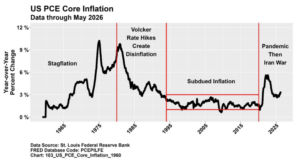
Our explanation for the 1994-2019 period of subdued inflation rests on the concept that the economic system internally determines its own inflation rate (i.e., inflation is endogenous to the system). To understand the inflation process one must identify the critical factors influencing the economic system that evolved over the period and ushered in the low inflation path. Our factors are globalization, the rise of the Internet, and demography. Globalization and the era of more open trade brought lower price goods, many from China to the US. The Internet allowed comparison shopping, with the rise of Google, eBay and Amazon, and shifted pricing power from corporations to consumers. Demographic trends added more workers to the labor force, allowing for real GDP to expand without putting upward pressure on prices.
Going forward from 2026, and assuming an eventual arrangement to re-open the Strait of Hormuz for shipping traffic, we would argue that the two of the three drivers of the 25-year period of subdued inflation have reversed. With tariff policies in flux, the era of globalization is in retreat. With the aging of the population, fewer births, and aggressive immigration policies, demographic trends now point to a stagnant to slow growing labor force. Our conclusion is that the US core inflation rate will not return to the 2% path of the 1994-2019 period. Instead, absent recessions when inflation may decline, the core inflation rate is more likely to center around a 3% path,
regardless of whether the Fed adjusts short-term rates a little higher or not.
What does the endogeneity of inflation and money mean for the conduct of Fed policy?
The argument here is that the US economy is much less interest rate sensitive than it once was. If this is true, then it follows that the Fed has considerably less ability to fine-tune the future path of inflation by adjusting interest rates. This would mean the Fed should consider adopting a federal funds rate target zone consistent with providing a small premium, say 1% or 1.5%, over the estimated long-term path of inflation and keeping rates on hold unless a major shock caused severe problems for the financial system and the economy.
Admitting that central banks have little power to fine-tune an economy is not something the Fed’s FOMC is likely to embrace. Note though, in a crisis, the Fed’s job remains to mitigate systematic risk. Lowering rates and buying distressed assets from the banking system would still be a totally appropriate policy response for a financial panic, as happening in 1929 when the Fed did not respond or the subprime
crisis of 2008 when the Fed did respond.
Note that just because we arguing that small rate changes do not impact the US economy or inflation, we still believe that short-term interest rate changes can affect long-term bond yields and have an impact on equity valuations.
As a final point, if we are right that the economy-determined trend inflation rate may be more like 3% going forward instead of the 2% in the 1994-2019 period, then the Fed is going to have to decide whether it wants to raise rates high enough to cause a recession to push inflation back down to its 2% target. And even if the Fed does cause a recession and inflation dips down to or below 2%, it might not remain there once the economy recovers. Expect a lot of debate at future Fed FOMC meetings, including more dissenting votes, as there are no easy answers to the challenges pushing inflation lower when the economy has become much less interest rate sensitive than in the distant past.

