
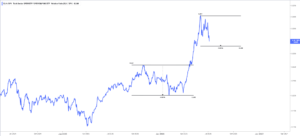
For over a year, the tech trade was simple: own the chips, sell the software. The narrative was that AI would eat the software stocks alive — a “SaaS-pocalypse” spreading like a plague straight out of The Walking Dead. I think this piece is timely, because two things are happening at once: software stocks have been quietly building relative strength over the past few weeks, while the semiconductor and broader tech trade has started to act heavy in recent sessions. Below is the XLK/SPY ratio in decline — a move I’m comfortable labeling a correction, as long as it holds above the depth of the prior decline at 9.63%.
Our Tech Holdings at Inside Edge Capital
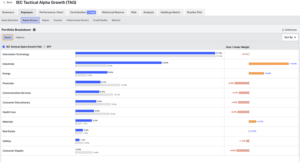
Over at Inside Edge, as I manage the portfolios, I find myself essentially market weight technology at 37.3% — right in line with the S&P’s 37.4%. That’s a big number; I consider any single sector at 37% to be a significant chunk of a portfolio. Unrelated, but check out the 3x weighting of Industrials at 23% versus the S&P 500’s 8.4%. I’m watching that sector very closely too.
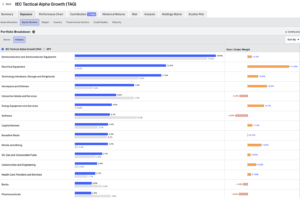
Drilling down to our industry weightings, we’re holding 18.8% in Semis and Semi Equipment — slightly overweight the market’s 17.6%. Our biggest underweight is Software, at 4.7% versus the S&P’s 8.3%.
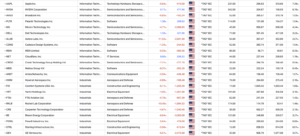
I’m going to share our exact holdings in the Tactical Alpha Growth (TAG) portfolio below. To those Inside Edge investors who don’t have an allocation in TAG — please don’t fret. The exhaustive planning process you went through with Kyle determined that Strategic Income and Growth (SIG), or one of our other two equity portfolios, is a better fit for your goals.
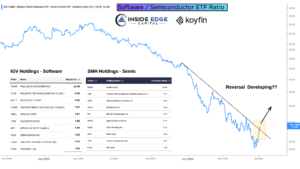
Software is turning up against semis
After more than a year of underperformance relative to the semiconductors, the IGV/SMH ratio (Software ETF / Semiconductor ETF) bottomed near 0.13 last month and has turned back higher, breaking through the black dotted trendline resistance — a sign of a possible reversal in the software stocks’ misfortunes.
This has become one of the most crowded trades in recent memory, with the masses long semis and short software. As you can see in the top-10 holdings of both ETFs — and remember, you have to know what you own when you hold ETFs and mutual funds! — money rushed into Nvidia, TSM, and Micron, and out of Palantir, ServiceNow, and Salesforce.
It’s not just semis — software is turning up against everything!
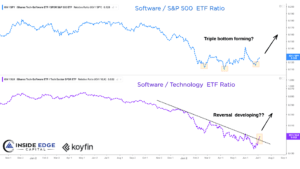
Here’s why I think this may be a structural shift rather than just a few days of profit-taking in semis ahead of Q2 earnings. In the bottom panel of the chart below, the Software ETF is turning higher against the technology ETF (XLK) after more than a year of relative weakness.
And in the top panel, software is actually turning higher against the entire S&P 500 — off a triple bottom that started early in 2026. This possible reversal has been about five months in the making! Software showing relative strength against the semis, or even against technology, is one thing. But when it starts gaining ground on the broader market, that’s a significantly more compelling story.
I spent most of my morning reading through a 65-page research report from the brilliant team at Jefferies called “What’s Ailing Software.” It practically broke my brain, but here’s the synopsis. It distills the market’s AI fears into ten “walls of worry” and concludes that most are already priced in — with a bottom line of “software is not dead, but weak software is.” The firm argues that systems of record stay durable because AI agents have to plug into them, which strengthens the incumbents rather than replacing them, and that the near-term margin pressure is largely already embedded in today’s beaten-down valuations.
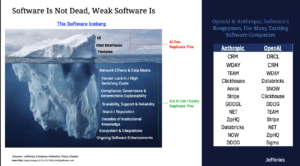
Jefferies’ bigger-picture point is simple: unless one giant AI model ends up running everything, the corporate world stays fragmented — because every company’s data is locked up and walled off from outside vendors, nothing like the clean, uniform data a company like Google gets to train on. That’s why AI has taken off quickly in tidy areas like coding, but will be a lot slower to spread across the rest of a business. And that’s why the edge goes to the incumbents already sitting on all that messy enterprise data.
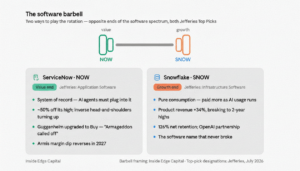
Their playbook is to stay overweight the “token path” — the infrastructure and hyperscaler names positioned to win as AI usage scales — while being more selective on application software. Within that framework, both of the stocks below are named Jefferies Top Picks: ServiceNow in application software, and Snowflake in infrastructure software.
I tapped Claude to build the graphic below, laying out a barbell approach to trading the software recovery.
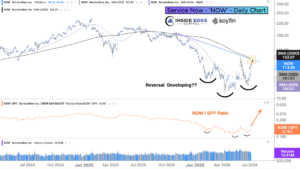
For the deep-value end of the barbell, let’s start with ServiceNow (NOW). It’s one of the more punished names in the group, down roughly 50% from its high. But the daily chart is now carving an inverse head-and-shoulders — a classic bottoming pattern — around the $100 zone. The stock is starting to move higher, targeting the 200-day moving average at $132 along with the blue downtrend line. In the panel below, you’ll see that NOW has been carving out an inverse head-and-shoulders against the S&P 500 as well, which suggests we may see strength against the broader market too. I don’t yet own ServiceNow, but I’m getting close to adding it to the growth portfolio for our investors.
Three reasons the fundamentals back up the chart:
Wall Street is flipping bullish. Guggenheim upgraded ServiceNow to Buy on July 1 in a note it framed as “Armageddon called off.” Of the 48 analysts who cover it, 10 rate it a Strong Buy and 34 a Buy, with an average price target of $141.12 against a last trade of $112.77.
Jefferies says the fear is overblown. Its verdict: “software is not dead, weak software is.” ServiceNow is a system of record that AI agents have to plug into, which strengthens it rather than replacing it. Jefferies names it a Top Pick, and the margin dip that scared investors is a temporary cost of its Armis acquisition that management expects to reverse in 2027.
Valuation. EBITDA has grown around 30% a year over the past three years and is expected to slow to a still-respectable 21% over the next four. With 2027 EPS expected at $5.03, the stock trades at a cheap 22x forward multiple.
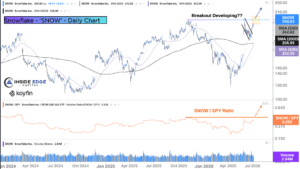
Now to the other end of the barbell — the software name that kept acting like a growth stock even as most of the group fell apart. Snowflake (SNOW) is trying for a third time to break out above its late-2025 highs, up around the $300 level, after an initial pullback that traced out a flag pattern over the past month following its massive gap higher.
From a fundamental standpoint, Snowflake gets paid when AI runs — not when people log in. It charges for the data and AI workloads its customers process, which is pure consumption. So the AI boom that threatens seat-based software is a direct tailwind for Snowflake. Jefferies puts it in the “token path” — the infrastructure layer built to win from AI — and also names it a Top Pick.
And its growth is speeding up, not slowing down. Last quarter, EPS beat expectations by 22% and product revenue grew about 34%, blowing past the company’s own guidance, with a record operating margin, a 126% net-retention rate, and a new partnership with OpenAI. That was the massive gap you see in the chart — the one that set up the month-long flag pattern I mentioned above.
Expected 2027 EPS of $2.69 against a last trade of $268 puts Snowflake at a very expensive 100x next year’s earnings. But with year-over-year EPS growth running at 1,823%, 292%, (15%), and 51% since 2022 — and another 54% expected next year — we’re going to pay a high price for that growth.
Bottom Line
The most one-sided trade in tech — long chips, short software — looks like it’s finally starting to unwind. Software is now turning up against semis, against the tech sector, and against the whole market all at once. There are two clean ways to play it, at opposite ends of the barbell: ServiceNow, for a beaten-down turnaround with Wall Street coming back to it, and Snowflake, for proven strength and growth riding the AI-usage wave.
Inside Edge Capital is a boutique registered investment advisor based in Saratoga Springs, NY, led by 15-year CNBC contributor Todd Gordon. We manage client capital through actively managed strategies that combine technical and fundamental analysis, seeking to add value beyond passive indexing. Alongside our portfolio management, we provide comprehensive financial planning to ensure every investment decision fits within a client’s broader goals.
Disclosures: Todd does not yet own SNOW or NOW, personally or for clients of his wealth management company, Inside Edge Capital, LLC. Charts shown are from Koyfin.

