
Three officials favored an immediate increase as Kevin Warsh rejected the idea of a “soft” 2% inflation target
The Federal Reserve left interest rates unchanged Wednesday, but the vote and Chairman Kevin Warsh’s message pointed in the same direction—the next move could be higher.
The Federal Open Market Committee voted 9-3 to maintain the federal-funds target range at 3.5% to 3.75%. Beth Hammack, Neel Kashkari and Lorie Logan dissented, each preferring an immediate quarter-point increase.
Rate futures moved quickly to price in a greater chance that they will get their way at the Fed’s next meeting. CME FedWatch showed a 74.5% probability that the central bank will raise rates by 25 basis points in September and a 2.9% chance of a half-point increase. The combined probability of any hike stood at 77.3%, compared with a 22.7% chance that rates remain unchanged.
The decision was a hold, but almost everything surrounding it was hawkish.
The Fed described economic activity as expanding at a solid pace, with strong productivity growth and capital investment. Job creation has kept up with growth in the workforce, while the unemployment rate has changed little. Inflation, however, remains above the central bank’s 2% goal, with the conflict in the Middle East and higher energy prices adding to the pressure.
Warsh used his opening remarks to confront any belief that the Fed might tolerate inflation above its stated objective.
“There is no soft inflation target,” Warsh said. “There is no soft implicit target, not on this committee’s watch. There’s only a target, and it’s 2%.”
That carried more weight alongside the three dissents. Hammack, Kashkari and Logan did not just object to the language of the statement or ask to preserve flexibility, they wanted tighter monetary policy now.
Warsh acknowledged that more than five years of above-target inflation would not be reversed in a matter of weeks or by a brief run of favorable data. The Fed’s credibility, he said, would rest on delivering price stability rather than continually describing its intentions.
“This Fed will not waver,” he said.
Warsh also defended the central bank’s retreat from the detailed guidance investors grew accustomed to under previous leadership. Treasury yields have risen materially since the Fed’s June meeting even though the committee did not change its policy rate. Warsh said markets were reacting to economic data without waiting for officials to interpret every release.
“Market participants are learning to play the ball, not the referee,” he said.
That approach places more weight on each inflation, employment and growth report before the September meeting. The Fed is promising less guidance, while traders are being left to decide how much evidence would compel the committee to act.
Strong business investment adds another complication. Warsh said spending on high-tech equipment and software associated with AI has grown at a nearly 20% rate over the past four quarters, helping support manufacturing. The boom is also raising prices for memory chips, logic chips and related infrastructure.
The question for the Fed is whether those increases are isolated consequences of an investment surge or early signs of broader inflation. Wednesday’s vote showed that at least three policymakers believe the risk already warrants higher rates.
How to read CME FedWatch
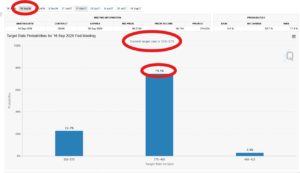
The CME FedWatch tool turns prices from 30-Day Fed Funds futures into probabilities for the target rate after upcoming Fed meetings. Those contracts reflect the market’s expectation for the average effective federal-funds rate during a given month. CME’s calculations generally assume that the Fed changes rates in increments of 25 basis points.
Start by selecting an FOMC meeting date along the top of the tool. The chart then displays the possible target ranges after that meeting.
For September, the current target range is shown as 350 to 375 basis points, equivalent to 3.5% to 3.75%. The 375-to-400 bar represents one quarter-point hike. The 400-to-425 bar represents two quarter-point hikes, or a single half-point increase.
The summary table groups those outcomes into three categories—easing, no change and hiking. That is why the chart can show a 74.5% probability for the most likely target range while the table reports a higher 77.3% probability of a hike. The latter includes every outcome in which rates rise.
FedWatch is a live reading of market prices, not a forecast issued by the Fed. Its probabilities can change as traders react to inflation figures, employment data, energy prices and comments from policymakers. CME describes the tool as a measure of rate expectations implied by Fed Funds futures trading.
For now, those prices tell a straightforward story. The Fed declined to raise rates in July, but traders increasingly expect the pause to end in September.

